
Overview
This article explores the Resolution Communication Gap: the breakdown between receiving a tenant complaint and documenting, communicating, and confirming its resolution across all relevant parties. It examines how fragmented communication across email, text messages, phone calls, voicemail, and spreadsheets creates missed updates, duplicated work, slower responses, and incomplete records. The article identifies three common failure points: acknowledgement, ongoing updates, and resolution records, and explains how connected communication workflows can address each one. It also looks at how structured service requests, scheduling, and documentation can improve tenant satisfaction while giving owners greater visibility and confidence in how their properties are managed. For growing property management agencies, closing this gap can reduce administrative workload, strengthen retention, and create a more consistent standard of service.
A tenant submits a maintenance complaint about a hot water system. They send it by email because that is what the agency previously asked them to do.
Three days pass without a response. The tenant follows up by text to the property manager's mobile. The property manager is across town at an inspection and sees the message hours later. They call the plumber. The plumber confirms availability for Friday by voicemail.
The property manager relays this to the tenant by text. The tenant replies asking for a morning appointment. That request goes back to the plumber by another call. The plumber agrees. The property manager updates the tenant again by text.
Friday arrives. The plumber attends. The hot water system requires a part that is not on the van. A return visit is needed. The tenant calls the agency, frustrated. The property manager, now managing three other active complaints, has to reconstruct the history of this job from a phone, an email inbox, and a voicemail to brief themselves before returning the call.
The complaint is eventually resolved. But the record of how it was handled exists across five separate channels, none of them connected.
When an owner asks what happened with the hot water complaint at their property, the answer requires finding all five.
This is the Resolution Communication Gap: the distance between a tenant's complaint being received and its resolution being documented, communicated, and confirmed in a form that every relevant party can access. In property management, most of the cost of this gap does not show up as a single identifiable expense. It accumulates in manager time, owner confidence, tenant satisfaction, and the quiet erosion of the agency's reputation with bothWhy Communication Breaks Down in Property Management
Property management is fundamentally a communication business. Every interaction between a tenant, a property manager, a tradesperson, and a property owner involves an exchange of information that needs to be accurate, timely, and traceable.
The challenge is that communication in most growing property management agencies has no central channel. It is distributed across whatever medium was most convenient at the moment the interaction happened.
A tenant texts because it is faster than emailing. The property manager replies from their mobile because they are not at their desk. The tradesperson confirms by voicemail because they were driving. The owner is updated by email because that is what they prefer. By the time the job is complete, the communication trail for a single complaint spans four channels, managed by one property manager who is simultaneously handling dozens of other interactions across the same fragmented mix.
Industry research from BrickVest's 2025 property management communication analysis found that 67% of property managers report communication inefficiencies as a primary operational challenge, particularly when coordinating emergency repairs and routine maintenance requests. The National Association of Residential Property Managers' (NARPM) 2025 time study found that the average property manager spends 8.3 hours per week on routine tenant communication for a 100-property portfolio, a figure that automation and centralisation can reduce to 1.2 hours.
The 2024 Property Management Trends Report, conducted by LeadSimple and The Harris Poll, found that 26% of property owners identify communication as one of their top day-to-day challenges. Among owners who use a property manager, speed of communication ranked as the third most important evaluation factor, behind only professionalism and tenant satisfaction. The report found that most of these communication concerns centre on maintenance coordination, updates, and response times.
Communication is not a side function of property management. It is the product. When it is fragmented across channels that are not connected, the product is inconsistent, regardless of how capable the people managing it are.
The Three Points Where Communication Fails
In the property management agencies we work with across Victoria and New South Wales, tenant communication breakdowns almost always occur at one of three points in the complaint lifecycle.
Point 1: The acknowledgement gap
A tenant submits a complaint. It enters an inbox, a portal, a text thread, or a phone message, depending on how they chose to contact the agency. Without a structured intake process, there is no automatic confirmation that the complaint has been received. The tenant waits, not knowing whether anyone has seen it. After 24 hours with no response, they follow up, creating a second interaction for the same complaint before the first has been addressed.
NAA's 2025 Resident Communication Survey found that 29% of tenants do not regularly check email, 18% have outdated email addresses on file, and 44% ignore notices posted on common areas or doors. Single-channel communication mathematically cannot reach every tenant every time. The acknowledgement gap is a structural feature of an agency that relies on one channel to manage all incoming requests.
Point 2: The update gap
Once a complaint is acknowledged and a tradesperson is engaged, tenants typically want to know two things: when the work will happen and whether it has been completed. In a fragmented communication system, both of those updates require manual action by the property manager.
MRI Software's 2026 Australian property management analysis found that tenants want clear timelines for resolution and regular updates throughout the process. Establishing open channels of communication builds trust and transparency. When updates require the property manager to manually reach out to the tenant after each milestone, they are dependent on the manager remembering to do so, across however many active complaints they are managing simultaneously.
The CRE Insight Journal's 2026 analysis of tenant satisfaction data found a consistent pattern across more than 35 years of KingsleyIndex data: tenants who feel a complaint was heard and addressed are more likely to renew than tenants whose concerns were handled but never acknowledged. The handling of the complaint matters. The communication around it matters equally.
Point 3: The resolution record gap
When a job is complete, the record of its resolution needs to exist in a form that the agency, the owner, and if necessary a regulatory body can access. In a fragmented system, the resolution record is the email thread, the text exchange, the invoice from the tradesperson, and the note in the spreadsheet, assembled by whoever needs it, whenever they need it, from wherever those pieces happen to be stored.
When an owner queries a repair, or a dispute arises with a tenant about whether an issue was resolved, or a compliance audit requires documentation of maintenance response times, that assembly exercise takes time and produces incomplete records.
LeadSimple's 2026 property management communication research makes this cost visible: a fragmented communication stack quietly undermines reputation, retention, and referrals. Owners judge an agency on how informed they feel. Tenants renew based on whether they feel heard. A unified approach to communication turns three scattered conversations into one continuous thread.
What Structured Communication Actually Changes
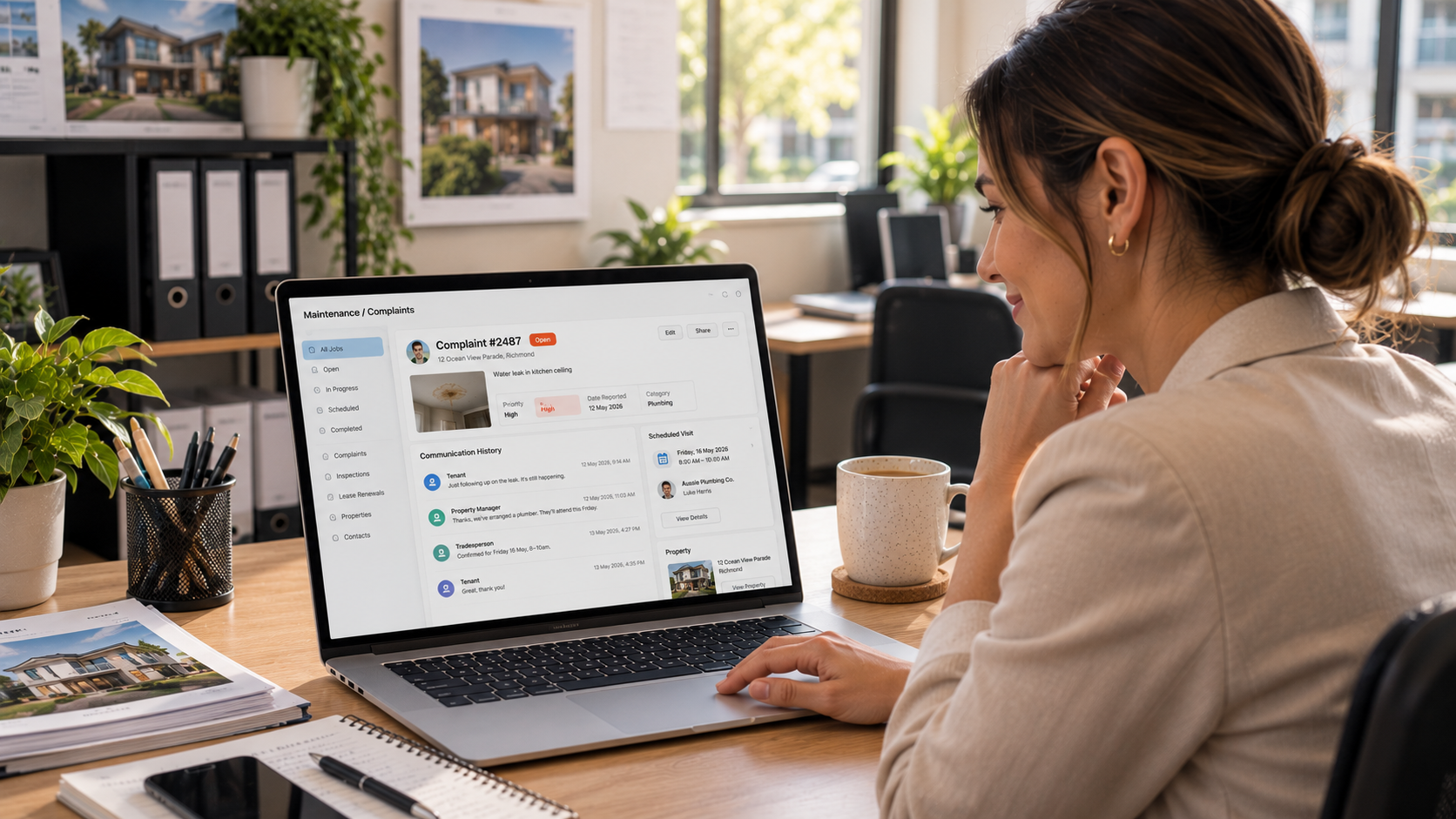
The goal of structured communication in property management is not to add more steps. It is to make the steps that already happen visible, trackable, and automatically communicated to the right people without requiring the property manager to manually manage every touchpoint.
When a tenant logs a complaint in a service desk, the acknowledgement is automatic. The tenant knows their complaint is received. The property manager has a single record to work from, not a message spread across three channels.
When the job is scheduled, the scheduling detail is attached to the complaint record. The tradesperson has what they need before attending. The tenant receives an update when the appointment is confirmed. When something changes, the update goes out once from one system; not as a separate text, call, and email from the same manager.
When the job is complete, the resolution is recorded against the complaint, alongside the invoice, the authorisation, and the communication history. The owner can be updated with a single reference to a complete record. The property manager does not need to reconstruct the history from their phone.
This is the operational shift from fragmented channels to a connected system: not fewer communications, but communications that are structured, tracked, and linked to the correct property and the correct complaint from the moment they happen.
chx4-Work, supplied by FinalSprint, brings this connected communication model to property management agencies growing from 50 to 300 properties. The service desk gives tenants a structured intake point with automatic acknowledgement. Scheduling connects the job, the tradesperson, and the communication history in one view. Every update, every confirmation, and every resolution is logged against the correct record — accessible by the property manager, the agency principal, and where appropriate the owner, without an inbox search.
Setup is handled by the FinalSprint team, with most agencies operational within days. The platform is built to work alongside the way a growing agency already operates, replacing the fragmented communication layer with one that runs consistently.
In the property management agencies we work with across Victoria and New South Wales, the shift from multi-channel complaint management to a connected system consistently produces three improvements: faster acknowledgement of tenant requests, fewer missed follow-ups, and a complete, accessible record of every complaint and its resolution.
The Owner Relationship Depends on It
There is a dimension of the Resolution Communication Gap that property managers see clearly but rarely measure: the owner relationship.
Most owners do not contact their property manager every week. They contact them when something needs attention or when they want to understand how their investment is performing. When that contact follows a tenant complaint, the quality of the answer depends entirely on the quality of the record.
A property manager who can open one screen and walk an owner through the timeline of a complaint; when it was received, what action was taken, when the tradesperson attended, when the resolution was confirmed, is demonstrating the professional standard the owner is paying the management fee for.
A property manager who has to say "let me check and call you back," then spend 20 minutes searching across email, text, and a spreadsheet, is demonstrating the opposite, regardless of how well the underlying job was handled.
Coast and Valley Properties' 2026 property management communication guide notes that owners judge an agency on how informed they feel, and that good management is not just rent collection and repair dispatch. It is the structure and transparency that makes an owner confident their investment is being managed with care.
In the competitive Australian property management market, where owners are able to switch agencies with as little as 30 days' notice in some jurisdictions, the quality of communication is a retention issue as much as a service issue.
The Resolution Communication Gap closes when every complaint, from intake to resolution, runs through one connected system. Not because the property manager works harder. Because the system does the tracking, the updating, and the record-keeping that currently depends on no single message being missed across four separate channels.
This article is the third in the FinalSprint Property Management Series. For the first article on maintenance coordination, see The Hidden Cost of Poor Maintenance Coordination in Property Management (And How to Fix It). For the second on spreadsheet systems and scheduling, see Why Property Managers Still Run on Spreadsheets (And Why It's Breaking Your Portfolio at Scale).
Key Takeaways
-
The Resolution Communication Gap is where tenant satisfaction, owner confidence, and agency reputation intersect. It spans the distance between a complaint being received and its resolution being documented in a form every relevant party can access.
-
67% of property managers report communication inefficiencies as a primary operational challenge, particularly around maintenance coordination and emergency repair response (BrickVest, 2025).
-
The average property manager spends 8.3 hours per week on routine tenant communication for a 100-property portfolio (NARPM, 2025). That figure is avoidable with a structured, connected system.
-
The three points where communication fails: acknowledgement, updates, and resolution records, are all addressable with a service desk that connects intake, scheduling, and documentation in one system.
-
Tenants who feel heard are more likely to renew. KingsleyIndex data across 35 years and more than 2.2 billion square feet of property found that acknowledged and resolved complaints consistently improve renewal rates. The communication around the complaint matters as much as the resolution itself.
-
Owners judge agencies on how informed they feel. A complete, accessible complaint and resolution record is not just an operational tool. It is the evidence that professional management is actually being delivered.
-
Communication is the product. When it is fragmented across channels that are not connected, the product is inconsistent, regardless of how capable the property manager is.
Author Note & Disclosure: This article was written by FinalSprint. FinalSprint supplies Chx4-Work, the workforce and service management platform referenced in this article. The operational examples and product descriptions reflect how the platform can be implemented for growing property management agencies managing maintenance requests, tradespeople, scheduling, property records, and service communication. Outcomes vary depending on portfolio size, workflows, existing systems, implementation scope, connectivity, and adoption.
About FinalSprint: FinalSprint helps growing property management agencies replace fragmented maintenance processes, including email threads, text messages, spreadsheets, paper notes, and disconnected contractor communication, with practical systems that make maintenance requests easier to track and coordinate. Through Chx4-Work, agencies can manage service requests, tradesperson scheduling, property-related documents, task workflows, communication records, and workforce processes in one connected platform. Our focus is fast setup, straightforward adoption, and practical workflows that help property managers spend less time chasing updates and more time managing properties, tenants, owners, and service delivery.
Credentials: Based in Melbourne, Australia, FinalSprint has supported Australian businesses since 2017.
Sources Note: Where third-party research is mentioned, it is used to highlight common industry patterns. If you’re making a compliance, legal, or operational decision, review the original source of material and the requirements that apply in your state or territory, or seek appropriate professional advice.
References
-
BrickVest: "5 Communication Platforms Property Managers Should Know About in 2025," June 2025. https://brickvest.com/5-communication-platforms-property-managers-should-know-about-in-2025/
-
NARPM / US Tech Automations: "How to Automate Tenant Communication for 100% Delivery in 2026," March 2026. https://ustechautomations.com/resources/blog/tenant-communication-automation-how-to-guide-2026
-
LeadSimple and The Harris Poll: "2024 Property Management Trends Report: Communication Findings," cited via Hendricks Property Management / Sarents, April 2025. https://www.sarents.com/news/costs-of-communication-in-property-maintenance
-
LeadSimple: "5 Ways an Integrated Tech Stack Improves Property Management Communication," August 2026. https://www.leadsimple.com/blog/5-ways-an-integrated-tech-stack-improves-property-manager-communication
-
MRI Software Australia: "4 Common Tenant Complaints and What to Do," March 2026. https://www.mrisoftware.com/au/blog/4-common-tenant-complaints-and-what-to-do/
-
CRE Insight Journal: "The Data Behind Tenant Satisfaction Scores," March 2026. https://creinsightjournal.com/the-data-behind-tenant-satisfaction-scores/
-
NAA: cited via US Tech Automations: "2025 Resident Communication Survey." https://ustechautomations.com/resources/blog/tenant-communication-automation-how-to-guide-2026
-
Coast and Valley Properties: "How Should a Property Management Company Communicate with Owners and Tenants?," May 2026. https://coastandvalleypm.com/how-should-a-property-management-company-communicate-with-owners-and-tenants/
-
DialMyCalls: "Why SMS Has Become an Essential Communication Channel for Property Managers," August 2026. https://www.dialmycalls.com/blog/why-property-managers-use-sms
-
Facilio: "Property Maintenance: Services and Strategies (2025 Guide)," December 2025. https://facilio.com/learn/what-is-property-maintenance/
-
MrTask: "Property Management Maintenance Coordination," April 2026. https://mrtask.com/blog/community/property-management-maintenance-coordination
-
Atlas Global Advisors: "Scaling Property Management in 2024: A Guide to Growth and Efficiency," August 2024. https://atlasglobaladvisors.com/blog/scaling-property-management-in-2024-a-guide-to-growth-and-efficiency/
-
TenantCloud: "The 2024-2025 Property Management Trends Report," February 2025. https://www.tenantcloud.com/investing/property-management-trends-report
-
MrTask: "Property Management Maintenance Coordination," April 2026. https://mrtask.com/blog/community/property-management-maintenance-coordination
-
Skybridge Property Group: "Top 9 Property Management Challenges and Their Solutions," May 2026. https://skybridgeproperty.com/blog/property-management-challenges