The Hidden Cost of Poor Maintenance Coordination in Property Management (And How to Fix It)
Category: Maintenance Coordination | Reading Time: ~10 min | Sector: Property Management | Author: Michael Falconer, FinalSprint (owner of Chx4-work solution)
Overview: Poor maintenance coordination creates hidden costs for property management agencies through wasted staff time, frustrated tenants, compliance exposure, and declining landlord confidence. As maintenance requests move between emails, texts, phone calls, spreadsheets, and tradespeople, small communication gaps can quickly become delayed repairs and incomplete records. This article examines the three key breakdowns: the Request Gap, Scheduling Gap, and Document Gap, and how they affect growing property portfolios. It also explores how a connected service desk, digital scheduling, and document management can create a more efficient and auditable maintenance workflow. For Australian property managers, closing these gaps can help improve tenant experiences, strengthen compliance records, and give teams more time to focus on managing properties rather than chasing coordination.
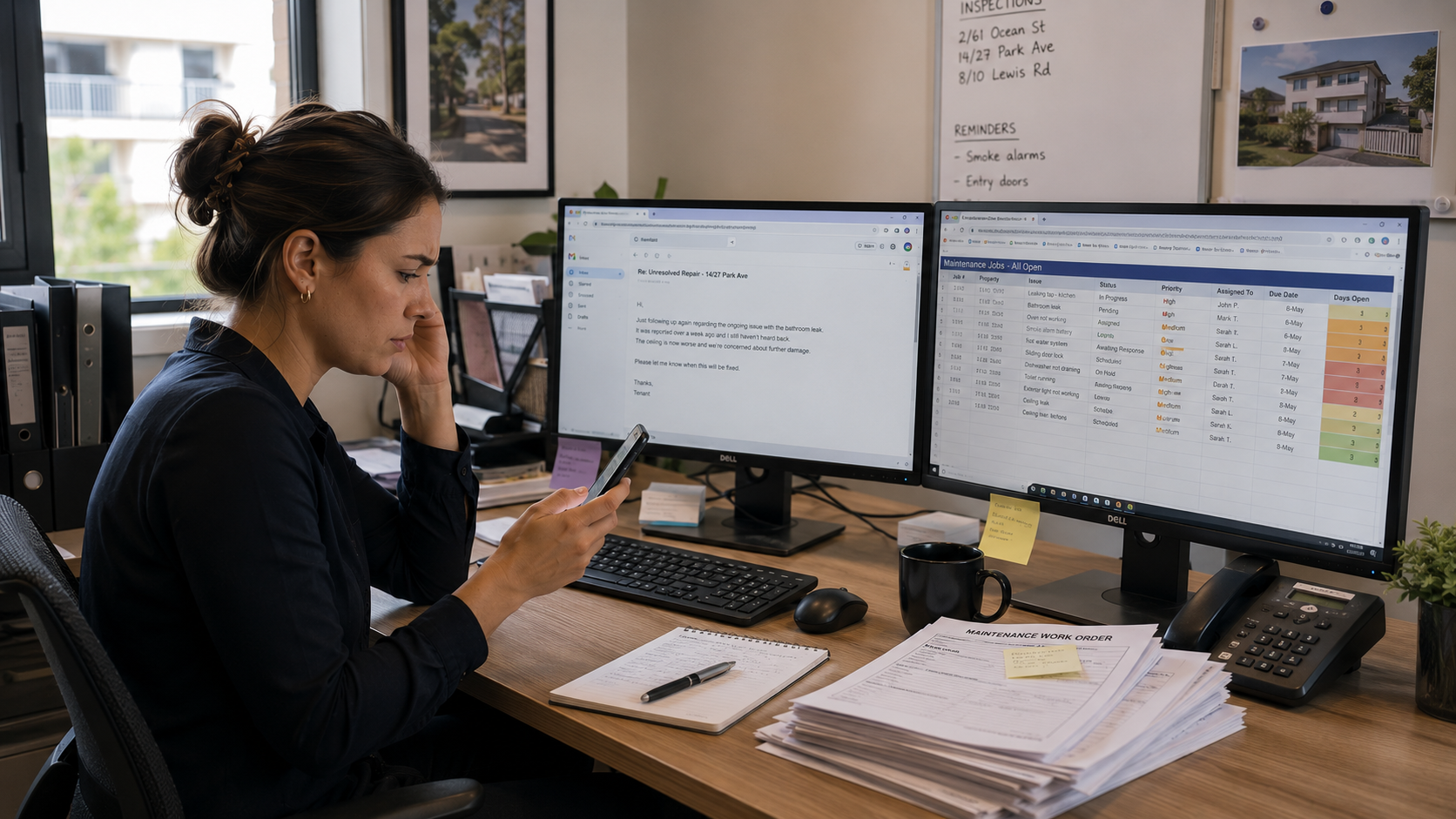
A tenant submits a repair request on Monday. A plumbing issue, not an emergency, but one that needs attention within the week.
The property manager receives it by email, forwards it to the plumber in a separate message, and makes a note in a spreadsheet. The plumber confirms that they can attend on Thursday. That confirmation comes back by text.
Thursday arrives. The plumber attended but the access code for the property has changed since the agency last updated its records. They leave without completing the job. The tenant contacts the agency. The property manager calls the plumber. A new visit is booked for the following Monday.
By this point, eleven days have passed since the original request. The tenant is frustrated. The owner does not yet know the repair is still outstanding. The property manager has handled the same request across four separate channels, none of which are connected to each other.
Nobody calls this a system failure. They call it a busy week.
But across a portfolio of 100 or 200 properties, that busy week has a cost in tenant satisfaction, in compliance exposure, in staff time consumed by coordination that should have happened automatically, and in the quiet erosion of landlord confidence in the agency managing their investment.
This is the Maintenance Coordination Gap: the distance between a maintenance request arriving and that request being resolved, documented, and confirmed with a clear record that everyone involved can see. Closing it is one of the most practical improvements a growing property management agency can make to its operations, its retention rates, and its risk profile.
Where Maintenance Coordination Breaks Down
Property management is, at its core, a coordination business. A property manager's role is to connect tenants who need things done with owners who have authorised those things to be done, via tradespeople who are qualified and available to do them and to document the entire process for compliance purposes.
When that coordination runs across email threads, text messages, phone calls, and spreadsheets that are not connected to each other, it creates a predictable set of failure points.
Research from MrTask's 2026 property management maintenance coordination analysis found that 40% of a property manager's weekly hours are typically consumed by maintenance coordination tasks. The same research found that tenants expect non-emergency repairs to be resolved within 72 hours before satisfaction scores drop materially, and that a tenant is three times more likely to renew when maintenance requests are resolved quickly and communicated clearly.
Facilio's 2025 property maintenance guide found that 87% of tenant complaints stem from poor maintenance experiences, with unresolved issues, slow turnaround times, and lack of communication as the primary causes. The same research found that a one-point improvement in resident satisfaction reduces move-outs by nearly 20%.
For a property management agency, tenant turnover is one of the most direct and measurable costs in the business. Vacancy periods, re-letting fees, new tenant placement, and the administrative load of a tenancy changeover all carry real costs that flow directly from a tenant's decision not to renew. When that decision is driven by a maintenance experience that felt slow, uncommunicated, or disorganised, it is a preventable cost.
The Skybridge Property Group's 2026 analysis of property management challenges identifies vendor management without a structured coordination system as a direct cause of scattered spending, inconsistent maintenance quality, and weakened tenant relationships. The problem is not usually a shortage of capable tradespeople. It is the absence of a system that tracks where every request is, who is responsible for it, and what has been communicated to the tenant while it is in progress.
The Three Coordination Gaps That Drive Most Maintenance Problems
In the property management agencies that we see across Victoria and New South Wales, maintenance problems almost always trace back to one of three specific gaps.
Gap 1: The Request Gap
When tenants submit maintenance requests by phone, email, text, and through portals, with no single intake channel, requests get missed or duplicated. A tenant who called on Friday and did not receive a response by Monday sends an email. Now the property manager is managing the same request twice, without a clear record of either.
A structured service desk that gives tenants one place to log requests, with automatic acknowledgement and status visibility, eliminates the request gap at the intake point. The tenant knows their request has been received. The property manager has one record to work from.
Gap 2: The Scheduling Gap
Once a request is received and a tradesperson is identified, the coordination of access, timing, and confirmation runs through informal channels. The plumber agrees verbally to Thursday. The property manager sends the access details by text. The tenant is notified by a separate email. None of these are connected.
When the access code changes, or the tenant needs to be home for the visit, or the tradesperson is unavailable and needs to reschedule, the re-coordination happens across the same fragmented channels. Each step requires a separate action by the property manager, who is simultaneously managing the same process for 15 other jobs.
Digital scheduling that connects the job, the tradesperson, the property, and the tenant communication in a single view eliminates the need for the property manager to hold this in their head. Changes update automatically. Confirmations are tracked. The manager spends time on decisions, not on chasing confirmations.
Gap 3: The Document Gap
At the end of a maintenance job, the record of what was done, when it was done, what it cost, who authorised it, and whether the tenant confirmed completion needs to exist in a form that is accessible, auditable, and linked to the relevant property.
In most growing agencies, this record is assembled after the fact from the email thread, the text message, the invoice from the tradesperson, and the note in the spreadsheet. When it is assembled, something is usually missing.
Australia's residential tenancy legislation across every state and territory requires property managers to maintain accurate records of maintenance and repairs. In Victoria, the Residential Tenancies Act amendments effective from November 2025 strengthen tenant protections and compliance requirements, including obligations around minimum rental standards and maintenance response. Non-compliance penalties range from hundreds to thousands of dollars (Collings, 2026). A document gap is not just an administrative inconvenience. It is a compliance risk.
What Structured Maintenance Coordination Actually Changes
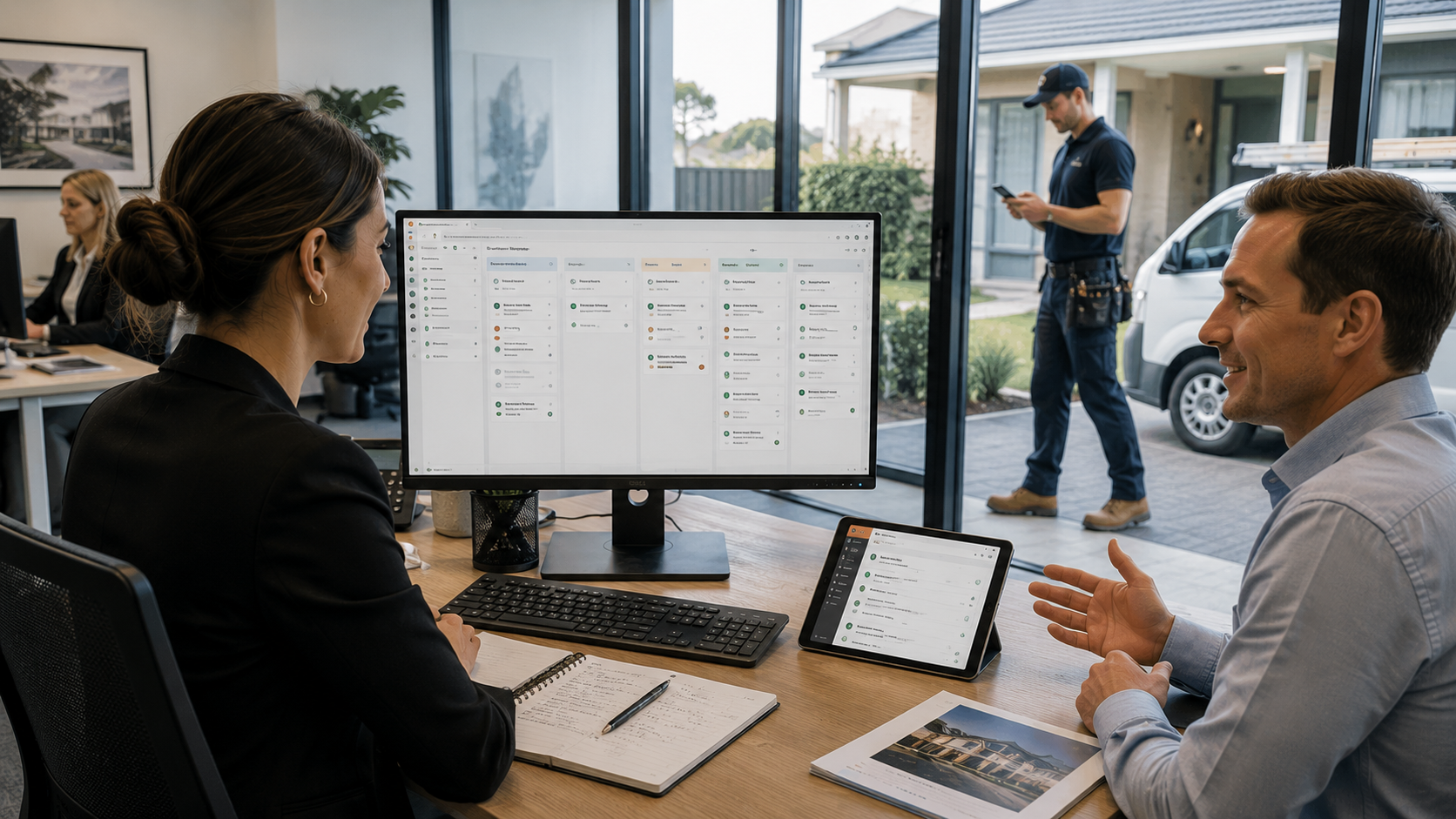
The goal of structured maintenance coordination is not to add more steps to the process. It is to make the steps that already happen visible, trackable, and automatically communicated to the right people at the right time.
When a service desk is in place, a tenant logs to a request once. It is received, acknowledged, and tracked from that moment. The property manager sees it in a single view alongside every other open request across their portfolio.
When scheduling is connected to the service desk, the job assigned to the tradesperson is linked to the request. The scheduling details, the property address, the access information, and any notes from the tenant, are attached to the booking and visible to the tradesperson before they leave for the site. When the access code changes, it is updated once and everyone who needs to know knows.
When documents are managed in the same connected system, the invoice from the tradesperson, the owner authorisation, the completion confirmation from the tenant, and the maintenance record for the property are all stored in one place, linked to the correct property, accessible without an inbox search.
This is the operational model that chx4-Work, supplied by FinalSprint, is designed to support growing property management agencies. The service desk gives tenants a structured intake channel. Scheduling connects the job to the tradesperson and the property. Document management keeps maintenance records, compliance documents, and authorisation trails in one place, accessible from any device.
Setup is handled by the FinalSprint team, typically within days. The platform is simple enough for tradespeople, property managers, and tenants to use without training because it is built around what they are already trying to do, without the friction.
In the property management agencies, we work with across Victoria and New South Wales, the shift from fragmented coordination to a connected system produces three immediate improvements: fewer missed or duplicated requests, less time spent chasing tradespeople and tenants for confirmations, and a complete, auditable maintenance record that does not need to be assembled after the fact.
The Compliance Dimension: Why Records Matter as Much as Repairs
For Australian property managers, compliance is not a background concern. It is an active and growing obligation.
Under Victoria's Residential Tenancies Act amendments effective November 2025, properties cannot be advertised or leased unless they meet minimum rental standards, including gas, electrical, and smoke alarm compliance. Maintenance records are part of the compliance story: evidence that a property is being managed to the standard the legislation requires.
Landmark Inspections' 2025 guide to Australian rental property compliance notes that across all states and territories, property managers are required to maintain records of repairs, maintenance authorisations, and compliance checks. In Queensland, the Residential Tenancies and Rooming Accommodation Act requires evidence of compliance with minimum housing standards introduced from 2024. In NSW, the Residential Tenancies Act 2010 sets clear expectations for rental providers. Non-compliance penalties across jurisdictions range from $500 to $5,000 or more (Collings, 2026).
Sprintlaw's 2025 analysis of Australian property management legal obligations notes that maintenance records, trust account documentation, and inspection reports must be maintained in a form that can be produced on demand. When these documents live in a combination of email threads, printed forms, and spreadsheets maintained by individual property managers, producing them on demand is not straightforward. When they live in a connected document management system linked to each property, it is important to them.
The compliance record and maintenance record are the same record. A system that captures maintenance of coordination also captures documentation that demonstrates compliance. That dual function is one of the most practical reasons for growing property management agencies to move from informal coordination to a connected platform.
Key Takeaways
-
The Maintenance Coordination Gap is where tenant satisfaction, owner trust, and compliance risk all intersect. MrTask's 2026 research found that 40% of a property manager's weekly hours are consumed by maintenance coordination. When that coordination is fragmented across email, text, and spreadsheets, it creates waste in every direction.
-
87% of tenant complaints stem from poor maintenance experiences (Facilio, 2025). A one-point improvement in resident satisfaction reduces move-outs by nearly 20%. In a business where tenant turnover is one of the most direct and measurable costs, that is a significant retention lever.
-
Tenants expect non-emergency repairs resolved within 72 hours before satisfaction drops. A tenant is three times more likely to renew when requests are resolved quickly and communicated clearly (MrTask, 2026).
-
The Request Gap, the Scheduling Gap, and the Document Gap are the three places where most maintenance coordination fails. Each is addressable with a connected system that replaces fragmented channels with a single, trackable process.
-
Australian property management compliance obligations are real and growing. Victoria's November 2025 Residential Tenancies Act amendments, Queensland's minimum housing standards from 2024, and NSW's legislative requirements all create documentation obligations that require accurate, accessible maintenance records. A system that captures coordination automatically produces those records as a by-product.
-
A service desk, connected scheduling, and linked document management are not separate tools. They are one connected workflow: request received, job scheduled, tradesperson briefed, work completed, record stored. That workflow, running automatically, is what frees a property manager to manage rather than coordinate.
Author Note & Disclosure: This article was written by FinalSprint. FinalSprint supplies Chx4-Work, the workforce and service management platform referenced in this article. The operational examples and product descriptions reflect how the platform can be implemented for growing property management agencies managing maintenance requests, tradespeople, scheduling, property records, and service communication. Outcomes vary depending on portfolio size, workflows, existing systems, implementation scope, connectivity, and adoption.
About FinalSprint: FinalSprint helps growing property management agencies replace fragmented maintenance processes, including email threads, text messages, spreadsheets, paper notes, and disconnected contractor communication, with practical systems that make maintenance requests easier to track and coordinate. Through Chx4-Work, agencies can manage service requests, tradesperson scheduling, property-related documents, task workflows, communication records, and workforce processes in one connected platform. Our focus is fast setup, straightforward adoption, and practical workflows that help property managers spend less time chasing updates and more time managing properties, tenants, owners, and service delivery.
Credentials: Based in Melbourne, Australia, FinalSprint has supported Australian businesses since 2017.
Sources Note: Where third-party research is mentioned, it is used to highlight common industry patterns. If you’re making a compliance, legal, or operational decision, review the original source of material and the requirements that apply in your state or territory, or seek appropriate professional advice.
References
-
MrTask: "Property Management Maintenance Coordination," April 2026. https://mrtask.com/blog/community/property-management-maintenance-coordination
-
Facilio: "Property Maintenance: Services and Strategies (2025 Guide)," December 2025. https://facilio.com/learn/what-is-property-maintenance/
-
APM Help: "Top 3 Reasons Why Poor Maintenance Coordination Can Lead to Tenant Turnover," July 2023. https://www.apmhelp.com/blog/maintenance/top-3-reasons-why-poor-maintenance-coordination-can-lead-to-tenant-turnover
-
Skybridge Property Group: "Top 9 Property Management Challenges and Their Solutions," May 2026. https://skybridgeproperty.com/blog/property-management-challenges
-
MP Property Group: "Rental Legislation Changes in Victoria 2025," February 2026. https://www.mppropertygroup.com.au/rental-legislation-updates-victoria-2025-compliance-guide/
-
Landmark Inspections: "Understanding Rental Property Compliance in Australia," August 2025. https://landmarkinspections.com.au/blog/everything-you-need-to-know-about-rental-property-compliance-australia/
-
Sprintlaw: "Property Management Duties: Australian Legal and Business Responsibilities," November 2025. https://sprintlaw.com.au/articles/property-management-duties-australian-legal-business-responsibilities/
-
Collings Real Estate: "5 Best Property Management Costs Tips for 2024," June 2026. https://www.collings.com.au/property-management-costs-commission-comparison/
-
Fraser's Property Australia: "Property Management Services in Australia: A Complete Guide (2026)," July 2026. https://www.frasersproperty.com.au/inspiration/property-management-services-meaning-benefits
-
ScienceDirect: "Navigating Building Defect Management in Australian Apartments," March 2026. https://www.sciencedirect.com/org/science/article/pii/S0263277226000097
-
ResearchGate: "Facility Management Trends in Asset Maintenance in Australia," December 2024. https://www.researchgate.net/publication/386423942_FACILITY_MANAGEMENT_TRENDS_IN_ASSET_MAINTENANCE_IN_AUSTRALIA