
Overview
This blog explores the often-overlooked cost of manual admin in construction and field services, showing how everyday processes like scheduling, onboarding, timesheets, and payroll quietly erode profitability. Drawing on industry research, it highlights how disconnected systems, paper-based workflows, and repetitive data entry lead to inefficiencies, errors, and compliance risks. Each of the four key areas is broken down to reveal how these hidden costs accumulate and impact operations at scale. The article concludes by showing how an integrated workforce management platform can eliminate these inefficiencies and restore control, accuracy, and productivity.
Ask most construction business owners where their biggest costs are, and they'll tell you about materials, subcontractors, and fuel. Rarely does anyone mention the hours their admin team spends chasing timesheets, the manager time lost to re-doing rosters, or the compliance exposure that comes from a payslip processed on a spreadsheet.
These are the hidden costs, and in Australian construction and field services, they're quietly draining businesses that are already working with thin margins.
The Australian Bureau of Statistics reports that the construction industry now employs over 1.29 million people, with total employment growing steadily through 2023–24. At the same time, labour costs have risen sharply, outpacing employment growth over the same period. In this environment, operational inefficiency isn't just inconvenient, it's expensive.
This article looks at where those hidden costs actually come from: job scheduling, onboarding, timesheets, and payslips, and what it looks like when you address them all at once.
The Problem With "Good Enough" Admin Systems
Many small-to-medium construction businesses run on a patchwork of tools that were never really designed to work together. A whiteboard for scheduling. A spreadsheet for timesheets. Email threads for leave requests. Payslips generated manually at the end of each fortnight.
Each piece works well enough on its own, until it doesn't.
Research published by CFMA (Construction Financial Management Association) in 2025 found that 96% of all construction data goes unused, with poor data management and siloed information as the primary cause. When your scheduling lives on a whiteboard, your timesheets in a spreadsheet, and your payroll in a separate system, there's no data flow between them. Everything gets manually re-entered, and every re-entry is a new opportunity for error.
McKinsey Global Institute research found that the construction industry has seen just 1% annual productivity growth over the past two decades, well below the broader economy. Manual admin is one of the key contributors to this gap. Time that should be spent building is spent reconciling data, chasing approvals, and fixing mistakes.
The hidden cost isn't any single error. It's the cumulative drag of a system that's always slightly behind.
Hidden Cost #1: Job Scheduling That Eats Manager Time
Every time a schedule changes, a machine is delayed, the weather closes in, a subcontractor is running late, someone has to update the roster, notify the affected workers, and confirm vehicle and equipment allocations. If that process is manual, it typically means phone calls, text messages, and an updated whiteboard that half the team won't see until they arrive at the office the next morning.
Research by Autodesk and Dodge Data & Analytics found that 66% of contractors report gathering and verifying field information to be a time-consuming challenge, one that directly leads to delayed project decisions and reduced profitability. When your scheduling system depends on someone physically being at a central location to update and communicate changes, you've built a bottleneck into the heart of your operations.
The real cost here isn't just the time spent making phone calls. It's the manager who should be on site supervising work but is instead standing at the whiteboard. It's the worker who drives to the wrong location because they didn't get the updated schedule. It's the equipment that sits idle because the allocation didn't update in time.
For a business running multiple crews across multiple sites, this isn't a minor inconvenience. It's a structural problem.
Hidden Cost #2: Onboarding That's Slower Than It Should Be
In construction and field services, getting a new worker to site quickly is often the difference between staying on schedule and falling behind. But manual onboarding slows that process significantly.
Verification of licences, certifications, and induction records done by hand takes time. Documents get lost. Duplicate data entry between HR and payroll creates gaps. And when certifications aren't tracked centrally, site managers are left guessing whether a worker is actually cleared for the task at hand.
The costs stack up fast. According to the Australian Human Resources Institute (AHRI), the average cost to hire a new employee in Australia is $23,860 per candidate, with an average time-to-hire of 40 days. Construction has the highest average staff turnover of any industry in Australia, 21% nationally, with 38% of construction organisations reporting turnover above 20%, according to AHRI data.
When workers leave and need to be replaced, and in construction, they do, a slow, manual onboarding process means you're not just paying to recruit. You're paying for every day that new worker isn't yet fully productive on site. Research from Brandon Hall Group found that an effective onboarding process improves new hire retention by 82% and productivity by over 70%. The inverse is also true: a clunky, slow onboarding process sets a poor first impression and loses productive days you can't afford to waste.
Hidden Cost #3: Timesheets That Can't Be Trusted
In construction, timesheets are the foundation of everything, job costing, payroll, invoicing, project reporting. When they're inaccurate, the damage spreads well beyond the payroll department.
Manual timesheets are filled from memory, often at the end of the week or even the fortnight. They're submitted on paper or via text message. They're re-entered into payroll systems by hand. At each step, accuracy degrades.
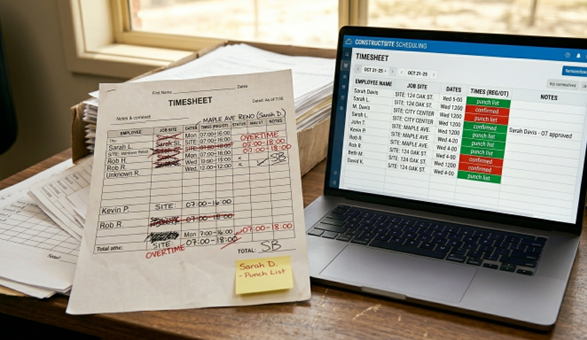
Research from Lumber and ConstructionOwners found that 26.5% of construction payroll professionals cite tracking hours and pay rates across sites as their most difficult challenge. Overtime miscalculations account for approximately 38.5% of payroll errors, while incorrect pay rate application accounts for a further 36.5%. Half of all payroll professionals in construction encounter one to three errors every month.
These aren't minor accounting annoyances. In Australia, payroll errors carry real consequences. Fair Work's payroll remediation programs have involved more than 1,500 participating businesses, most addressing systemic issues rather than one-off mistakes. ATO analysis has linked around 28% of payroll errors in mid-sized businesses to undocumented knowledge held by individuals, where critical payroll decisions live in people's heads rather than in systems.
Toggl Track's research on timesheet automation notes that automated timesheets improve data quality, support accurate billing, and enable reliable project insights. Manual timesheets do the opposite, and the business pays for it long after the timesheet is filed.
Hidden Cost #4: Payslips and Payroll Compliance That Keeps You Up at Night
Payroll in Australian construction is genuinely complex. Under the Building and Construction General On-site Award, you're managing minimum wages across different trade classifications, strict overtime rules (time-and-a-half after 38 hours, double time for weekends and public holidays), tool allowances, travel allowances, meal allowances, and Living Away From Home Allowances. Add superannuation, portable long service leave, and state-based payroll tax thresholds, and you have a system that's very easy to get wrong.
Xero's guide to construction payroll compliance in Australia notes that if super is missed for even one pay cycle, penalties may apply. And with workers moving between sites, roles, and project types within a single pay period, maintaining accuracy manually is a significant challenge.
The consequences of getting it wrong aren't abstract. An Ernst & Young study cited in Lano's research found that the average cost of fixing a payroll error is USD $291. With approximately 15 corrections per pay period common in mid-sized businesses, those costs accumulate quickly. The same research found that 14% of businesses faced litigation or compliance issues related to payroll errors in the previous 12 months.
For Australian SMBs in construction, the risk is particularly acute. Payroll compliance research from Alltech Payroll Australia notes that Fair Work's enforcement environment has tightened, and businesses with stronger payroll controls face fewer disputes and lower remediation costs when issues do arise. Manual payroll systems, where the rules live in someone's head rather than in a system, are one of the most common sources of compliance risk.

Addressing All Four at Once: What That Looks Like in Practice
The good news is that these four problem areas, scheduling, onboarding, timesheets, and payroll, aren't separate problems requiring separate solutions. They're connected, and a single well-designed workforce management platform can address all of them.
When scheduling is digital, changes are instant and visible to the whole team. No one needs to call the office to find out where they're going. Notes are attached to bookings, not buried in a text thread. Equipment and vehicle allocations update in real time.
When onboarding is centralised, new workers are set up once and their profile, certifications, contact details, site clearances, is immediately available to every manager who needs it. No re-entry. No guessing.
When timesheets flow digitally from the field into payroll, data accuracy improves and manual reconciliation disappears. Hours are captured when they're worked, not reconstructed from memory.
And when leave is managed in the same system as scheduling, conflicts surface before they become site problems. Approvals are tracked. Entitlements are visible. The schedule reflects reality.
This is exactly what chx4-Work, supplied by FinalSprint, is built to do. Designed for small-to-medium businesses in construction, engineering, and field services, chx4-Work brings scheduling, staff management, leave tracking, and operational notes into one platform that's accessible from anywhere.
Strzelecki Engineering, a well-established engineering firm based in Mirboo North, South Gippsland, used chx4-Work to replace their magnetic whiteboard scheduling system. The result was immediate: schedule changes that once required a chain of phone calls now happen in a few clicks. Workers access their allocations remotely. Notes on bookings replaced the back-and-forth messaging. And the system handles training days, equipment servicing, public holidays, and staff absences, all in one place.
"It has significantly improved the efficiency and productivity of Strzelecki Engineering," said Diana Mancarella. "Our company continues to thrive and knowing that we have a scheduling solution we can rely on allows us to move forward with confidence."
Key Takeaways
Before you move on, here's a quick summary of what the research tells us and what it means for your business:
- Job scheduling: Manual rosters create bottlenecks and require central office access. Digital scheduling allows real-time updates from anywhere, reducing manager downtime and miscommunication.
- Onboarding: With an average hire cost of $23,860 per candidate in Australia and construction's 21% average turnover rate, slow onboarding is a direct cost multiplier. Centralised digital onboarding gets workers productive faster.
- Timesheets: Over half of construction payroll professionals encounter recurring errors monthly. Automated timesheet capture reduces data loss, improves billing accuracy, and supports compliance.
- Payroll: Australia's construction award system is complex. Businesses relying on manual processing face compounding compliance risk under a tighter Fair Work enforcement environment.
- The fix: A single integrated workforce management platform addresses all four problem areas simultaneously without requiring a lengthy implementation or a large IT budget.
If any of these pain points sound familiar, the right time to look at a better system is before a compliance issue or a staff exodus makes the decision for you.
Author note & disclosure: This article was written by FinalSprint. FinalSprint supplies the Chx4-Work scheduling and workforce management platform referenced below. The operational examples and product descriptions reflect how the platform is typically implemented for small-to-medium construction and engineering businesses; outcomes vary depending on team size, workflows, connectivity, and adoption.
About FinalSprint: FinalSprint helps construction, engineering, and trade businesses replace manual workforce processes (whiteboards, spreadsheets, paper forms) with practical scheduling and workforce management systems. We focus on fast setup, straightforward adoption, and workflows that fit how site-based teams operate.
Credentials: Based in Melbourne, Australia, FinalSprint has supported Australian businesses since 2017.
Sources note: Where third-party research is mentioned, it is used to highlight common industry patterns. If you’re making a compliance or budgeting decision, review the original source material and your specific obligations (including Fair Work requirements) or seek professional advice.
References
Australian Bureau of Statistics. "The Nuts and Bolts of the Australian Construction Industry," June 2025. https://www.abs.gov.au/articles/nuts-and-bolts-australian-construction-industry
Lumber / CFMA. "The Hidden Costs of Manual Workforce Management in Construction," May 2025. https://www.lumberfi.com/blog/the-hidden-costs-of-manual-workforce-management-a-cfma-2025-preview
Lumber. "The Hidden Costs of Manual Payroll Processing," October 2023. https://www.lumberfi.com/blog/the-hidden-costs-of-manual-payroll-processing
Scale Suite. "Australian Employee Turnover Statistics 2026: SME Benchmarks, Costs and Industry Data." https://www.scalesuite.com.au/resources/australian-employee-turnover-statistics-2026
Toggl Track. "The True Cost of Hiring an Employee in 2024," January 2026. https://toggl.com/blog/cost-of-hiring-an-employee
Lano. "What Is the True Cost of Payroll Errors?," May 2025. https://www.lano.io/blog/what-is-the-true-cost-of-payroll-errors
ConstructionOwners. "Construction Payroll Compliance: The Hidden Cost Crisis," December 2025. https://www.constructionowners.com/news/what-construction-owners-must-know-about-payroll-compliance-and-prevailing-wage-regulations
Alltech Payroll Australia. "Payroll Compliance in Australia Beyond STP," March 2026. https://alltechpayroll.com.au/payroll-compliance-in-australia/
Xero Australia. "Construction Payroll Compliance Guide," August 2025. https://www.xero.com/au/guides/construction-payroll-compliance/
Kwant.ai. "Automated Workforce Management in Construction: ROI & Benefit," March 2026. https://www.kwant.ai/blog/automated-workforce-management-in-construction
Toggl Track. "Use Timesheet Automation to Boost Profitability & Productivity," February 2025. https://toggl.com/blog/timesheet-automation