Missed Appointments, Rework and Write-Offs: The Hidden Cost of Poor Field Service Coordination
Field Service ManagementWorkforce SchedulingTechnician DispatchWorkforce CoordinationMobile WorkforcePayroll AccuracyOperational EfficiencyService DeliveryScheduling SoftwareField Service Operations
Category: Workforce Management | Reading Time: ~10 min | Sector: Field Services | Author: Michael Falconer, FinalSprint (owner of Chx4-work solution)
Overview: As field service businesses grow, coordination challenges often emerge as small operational issues that quietly erode profitability and customer trust. Missed appointments, technician allocation conflicts, emergency schedule disruptions, payroll inaccuracies, and rework are rarely isolated incidents; they are symptoms of fragmented systems and poor visibility across the workforce. This article explores the hidden costs these coordination failures create and examines how they impact productivity, customer retention, labour costs, and compliance. Drawing on current industry research and practical field service examples, it shows why disconnected scheduling, communication, and time-tracking processes become increasingly unsustainable as teams scale. It also outlines how a unified workforce management platform can reduce operational friction and provide a single source of truth for dispatchers, technicians, and back-office staff.
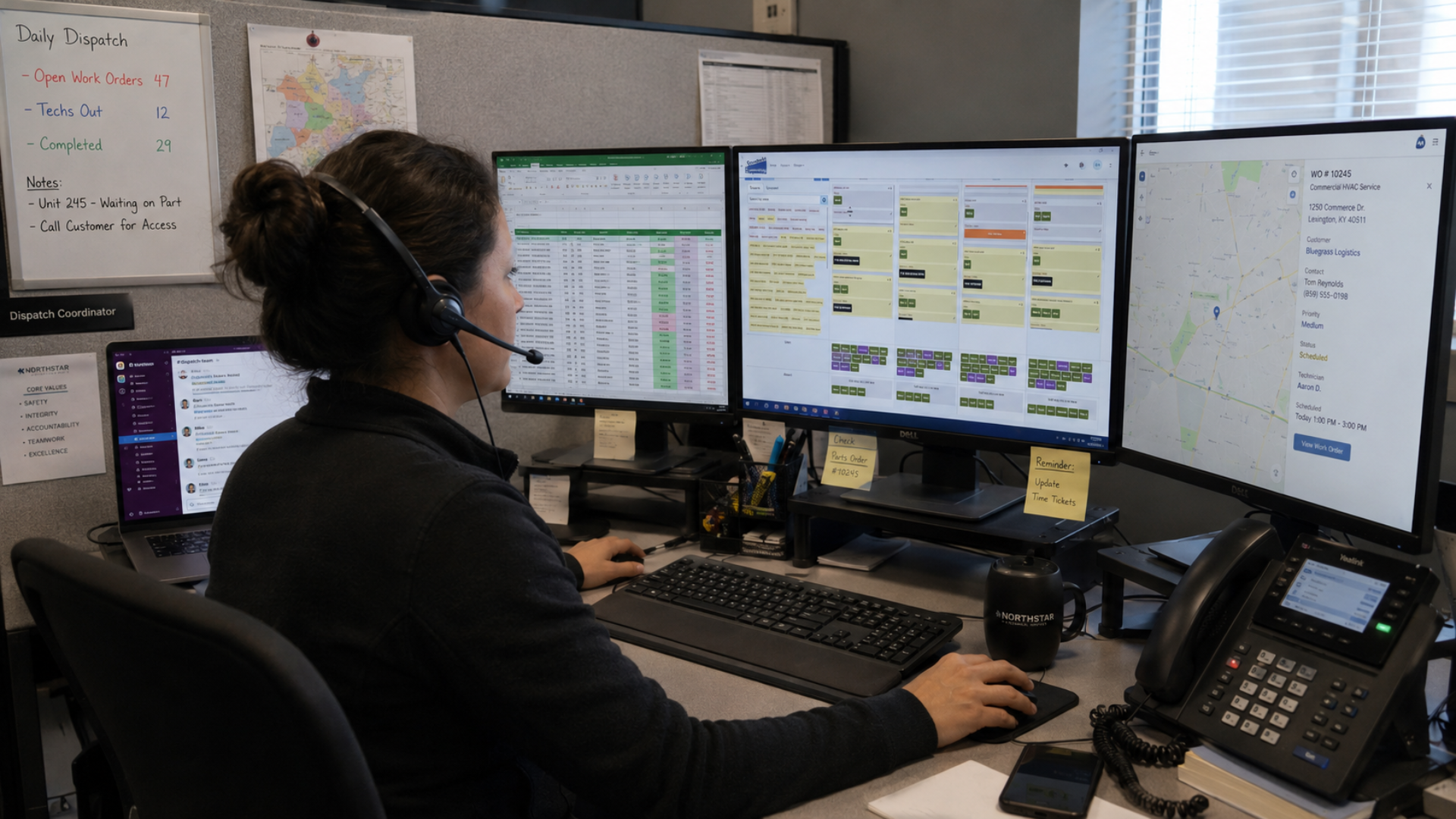
In a growing field service business with 10 to 50 staff, coordination problems rarely announce themselves loudly. They arrive quietly, one at a time, as small operational failures that each feel manageable.
A technician gets sent to a customer site and finds out another technician from the same business was already there yesterday. An emergency job overrides the afternoon schedule and the customer who was booked for 2pm never gets a call to say they are waiting for nothing. A job gets signed off on site, the hours are logged from memory that evening, and the payroll processes a figure that does not match what was actually worked. A rework visit is needed because the first technician did not have the right information before arriving.
None of these is a catastrophe on its own. But across a team of 15 to 30 mobile technicians running multiple jobs a day, they accumulate into something that does matter: missed revenue, broken customer trust, and a payroll that does not reflect reality.
If you are relying on a spreadsheet, a group chat, and phone calls to coordinate your field team, you are not running a bad operation. You are running an operation whose coordination tools have not kept up with how busy it has become.
Technician Allocation Conflicts: When Two People Are Sent to Do One Job

Allocation conflicts happen when the same technician is committed to two jobs at the same time, or when two technicians are dispatched to a site that only needed one.
Both happen more often than most business owners realise, and both trace back to the same root cause: a scheduling system that does not show real-time availability.
When scheduling is managed manually, whether through a whiteboard, a shared spreadsheet, or individual text message chains, each update happens in isolation. The office manager books a technician for a 10am appointment. That technician receives an emergency callout at 9am and accepts it in the field. By the time the 10am booking is on their way to the site, the conflict has already been set. Nobody knew because nobody could see the full picture.
FieldServ.ai's analysis of double-booking in field service found that this scenario plays out most commonly when manual scheduling systems and real-time field decisions operate as two separate conversations. An office manager might schedule a service call while the technician simultaneously accepts an emergency job in the field, and neither person knows about the other's commitment until the conflict surfaces.
The cost of an allocation conflict is rarely just the awkwardness of two vans in one driveway. It is one technician's travel time and half a day wasted. It is a customer who notices the disorganisation and starts wondering whether the business they hired knows what it is doing. And it is a downstream effect on the rest of the day's schedule as the displacement ripples outward.
A 2025 Deloitte study cited by Fieldservicely found that balanced, conflict-free scheduling improves productivity and reduces labour costs by 12.3%. That figure reflects what is possible when allocation decisions are made from a single, live view of the team rather than from fragmented, out-of-date information.
Emergency Job Overrides: The Ripple Effect Nobody Plans For
Every field service business has a version of this moment: a client calls with an urgent issue that cannot wait. The job needs to happen today. Someone has to go.
The decision of who to send and which scheduled appointment to move is made in real time, under pressure, with incomplete information about where every technician currently is and how far into their current job they are.
Without live visibility of the team, the override decision becomes a best guess. The technician who gets redirected was closest, probably. The appointment that gets bumped was least urgent, hopefully. The customer who gets a late cancellation call will understand, maybe.
eLogii's 2025 field service management research found that without real-time location and job status data, it is nearly impossible to proactively adjust schedules or reroute technicians in time to prevent missed service commitments. The emergency job gets handled. But the downstream disruption to three other appointments, two of which had to be rescheduled, is the real cost of not having visibility before the decision was made.
FieldCamp's 2026 field service management challenge analysis identifies poor dispatch coordination as one of the top ten challenges facing field service businesses, noting that scheduling conflicts, delays, and missed service requests compound quietly until customers stop calling back.
The fix is not avoiding emergency overrides. Urgent jobs are part of a field service business and always will be. The fix is a system that shows the dispatcher, in one view, where every technician is, what they are working on, and when they are next available, so that the override decision is informed rather than guessed. That information reduces the disruption caused by the override and often reveals a better answer than the first instinct.
Customer Commitments Being Broken: The Cost That Does Not Show Up on an Invoice
In field services, the customer relationship lives or dies on reliability. A client who booked a 2pm appointment and waited until 4pm without a call is not a satisfied customer who experienced a minor delay. They are a customer who is weighing up whether to call someone else next time.
Research from eLogii's 2025 field service analysis found that repeated service level failures do not just lead to penalties. They damage reputation, hurt customer retention, and in some cases put contracts at risk. For field service businesses that rely on repeat work and referrals, the cost of a broken customer commitment is not just that day's job. It is the next job, and the one after that.
Fieldservicely's 2026 field service scheduling research found that 88% of customers expect live updates for service visits. When they know when the technician is coming and receive a notification if that changes, frustration drops significantly. When they simply wait and hear nothing, even a short delay feels like being ignored.
For a small field service business with 10 to 50 staff, reputation is one of the most important competitive advantages available. A large service company can absorb a missed appointment in a way that a growing local business cannot. Word of mouth, reviews, and repeat bookings all depend on consistent follow-through.
The businesses that manage this well have one thing in common: a simple, shared system where everyone, the dispatcher, the technician, and where appropriate the client, can see the current status of a job. When a schedule change happens, the client is notified before the appointment time passes. When a technician is running late, the office knows because the system shows it, not because the technician remembers to call.
Arrivy's 2026 field service management challenge guide notes that scheduling gaps, dispatch failures, and communication breakdowns are often hard to detect and compound quietly until customers stop calling back. That compounding is the hidden cost: not a single missed appointment but a gradual erosion of the trust that keeps a field service business growing.
Payroll vs Actual Work: When the Hours Processed Do Not Match the Hours Worked
Of all the coordination failures in a small field service business, the mismatch between payroll and actual work is the one most likely to create ongoing damage across multiple areas of the business simultaneously.
When hours are logged from memory, captured on paper, and re-entered into a payroll system by hand, the figure that gets paid is not necessarily the figure that was worked. Sometimes it is higher. Sometimes it is lower. The direction of the error matters less than the fact that neither the business nor the technician can be confident the number is right.
Horizon Payroll Solutions' 2026 research on time tracking errors and overtime disputes found that when time is captured in one system, approved in another, and keyed into payroll from a spreadsheet, errors become predictable. Disputes then become hard to resolve because the business has multiple versions of the hours: what the employee remembers working, what the supervisor recorded, and what payroll processed. The mismatch creates confusion and, eventually, frustration.
From a billing perspective, the same problem plays out in reverse. When the hours logged by a technician do not reflect the job that was actually done, the invoice is wrong. If it is lower than the work performed, the business loses margin. If it is higher than what the client believes was done, there is a dispute. Either way, the payroll and billing records are describing a different day from the one that happened.
Rhumbix's 2026 field operations analysis found that companies using AI-powered or digitally integrated time capture cut payroll errors by up to 90% and reduced processing time by 33%. The research notes that when field supervisors and payroll staff spend their time tracking down missing timecards, correcting data entry mistakes, and resolving disputes, the business is paying administrative wages for firefighting that should not exist.
Under Australia's Single Touch Payroll Phase 2 requirements, payroll data is now reported to the ATO in real time with every pay run. Errors that previously could be quietly corrected before end of financial year are now visible to the regulator the moment they are processed. For a field service business where the gap between what was worked and what was paid is a structural feature of a manual system, that is a compliance risk that sits in every fortnight's payroll run.
The simplest fix available is connecting time capture to the same system as the schedule. When the hours a technician logs on their phone are linked directly to the job they were allocated on the schedule, and when those hours flow directly into payroll without manual re-entry, the opportunity for a mismatch disappears. What was scheduled, what was worked, and what was paid all describe the same reality.
What Coordination Actually Costs, and What Fixes It
The four problems covered in this article, technician allocation conflicts, emergency job overrides, broken customer commitments, and the payroll versus actual work mismatch, do not come from different root causes. They come from the same one.
When operational information is fragmented across a whiteboard, a spreadsheet, a group chat, and a set of paper job sheets, coordination requires a human being to hold the complete picture in their head at all times. At five staff, that is possible. At 20 or 30 mobile technicians across multiple customer sites, it is not.
The information exists. The schedule was built. The jobs are allocated. But because that information lives in separate places, the dispatcher making a real-time decision cannot see all of it. The technician in the field cannot update it easily. The back office cannot trust it to process payroll accurately.
The fix is practical and, at the 10 to 50 staff stage, does not require an enterprise-level implementation.
chx4-Work, supplied by FinalSprint, is built for exactly this stage of a field service business. It brings scheduling, staff allocation, job notes, leave management, and workforce records together in one simple, mobile-accessible platform. When a callout arrives, the dispatcher has a live view of the team. When a technician completes a job, their time is logged in the same system the back office uses to generate the invoice. When leave is approved, it shows up in the schedule before anyone calls to ask why a technician is unavailable.
There is no long implementation. The FinalSprint team handles setup and provisioning. Most businesses are running within days. The platform is simple enough that field technicians adopt it without training programs, because it is built around what they already do, just without the paper.
Coordination problems in field services are not solved by working harder. They are solved by giving the whole team, dispatchers, technicians, and back office, a shared, simple view of what is actually happening.
For a look at how poor coordination creates similar cost leakage in reactive field service work, see When the Day Doesn't Go to Plan: Why Reactive Work Exposes the Cracks in Field Service Operations.
If your team is at the growth stage and these coordination problems are increasing as headcount grows, read Scaling from 10 to 80 Staff: Where Operations Have to Catch Up.
Key Takeaways
-
Allocation conflicts are a system problem, not a human one. When scheduling is managed manually without real-time visibility, two technicians ending up at the same site, or one technician committed to two jobs simultaneously, is a predictable outcome. A 2025 Deloitte study found that conflict-free scheduling improves productivity and reduces labour costs by 12.3%.
-
Emergency overrides cost more than the job they create. Without a live view of the team, a last-minute dispatch decision disrupts three other appointments to handle one callout. The downstream cost of the ripple effect is often larger than the emergency itself.
-
Broken customer commitments compound quietly. Arrivy's 2026 research notes that coordination failures erode customer trust gradually, with businesses often not noticing the impact until repeat bookings have already dropped. Fieldservicely found that 88% of customers expect live updates for service visits.
-
Payroll vs actual work mismatches are structural, not accidental. Horizon Payroll Solutions' research found that when time is captured in one system and keyed into payroll from another, errors are predictable. Rhumbix found that digitally integrated time capture reduces payroll errors by up to 90%.
-
STP Phase 2 has raised the compliance stakes. Payroll errors are now reported to the ATO in real time. A structural mismatch between hours worked and hours paid is a compliance risk in every pay run.
-
The fix is one shared view, not a new layer of complexity. A simple, mobile-first platform that connects scheduling, time capture, and back-office records eliminates coordination failures at the source, without a lengthy implementation or an IT project.
If this sounded familiar, read this next → The Hidden Cost of Disconnected Systems: Why Operations and Finance Must Share the Same Truth: the financial picture when operational data and billing records do not tell the same story.
Author Note & Disclosure: This article was written by FinalSprint. FinalSprint supplies the Chx4-Work scheduling and workforce management platform referenced below. The operational examples and product descriptions reflect how the platform is typically implemented for small-to-medium construction and engineering businesses; outcomes vary depending on team size, workflows, connectivity, and adoption.
About FinalSprint: FinalSprint helps construction, engineering, and trade businesses replace manual workforce processes (whiteboards, spreadsheets, paper forms) with practical scheduling and workforce management systems. We focus on fast setup, straightforward adoption, and workflows that fit how site-based teams operate.
Credentials: Based in Melbourne, Australia, FinalSprint has supported Australian businesses since 2017.
Sources Note: Where third-party research is mentioned, it is used to highlight common industry patterns. If you’re making a compliance or budgeting decision, review the original source material and your specific obligations (including Fair Work requirements) or seek professional advice.
References
-
ELogii: "Field Service Management in 2025: 7 Critical Issues and Proven Solutions," June 2025. https://elogii.com/blog/field-service-management
-
FieldServ.ai: "What to Do When You Double Book Field Service Jobs (Prevention Guide)," January 2026. https://blog.fieldserv.ai/double-book-field-service-jobs
-
Fieldservicely: "What Is Field Service Scheduling? Types, Models and Benefits," April 2026. https://www.fieldservicely.com/blog/what-is-field-service-scheduling
-
FieldCamp: "20 Top Field Service Management Challenges and Solutions," January 2026. https://fieldcamp.ai/blog/field-service-management-challenge/
-
Arrivy: "10 Field Service Management Challenges and How to Fix Them," June 2026. https://www.arrivy.com/blog/field-service-management-challenges-and-how-to-fix-them/
-
BuildOps: "The Comprehensive Guide to Field Service Scheduling." https://buildops.com/resources/field-service-scheduling/
-
Rhumbix: "Why Your Best Field Foremen Are Spending 6 Hours a Week on Paperwork," March 2026. https://www.rhumbix.com/blog/why-your-best-field-foremen-are-spending-6-hours-a-week-on-paperwork-and-what-its-costing-you
-
Horizon Payroll Solutions: "How Time Tracking Errors Lead to Employee Overtime Disputes," March 2026. https://www.horizonpayrollsolutions.com/blog/how-time-tracking-errors-lead-to-employee-overtime-disputes
-
Lano: "What Is the True Cost of Payroll Errors?," May 2025. https://www.lano.io/blog/what-is-the-true-cost-of-payroll-errors
-
Xero Australia: "Construction Payroll Compliance Guide," August 2025. https://www.xero.com/au/guides/construction-payroll-compliance/
-
Fieldwork HQ: "Field Service Management Trends in 2026," December 2025. https://fieldworkhq.com/2025/12/26/field-service-management-trends-in-2026/